
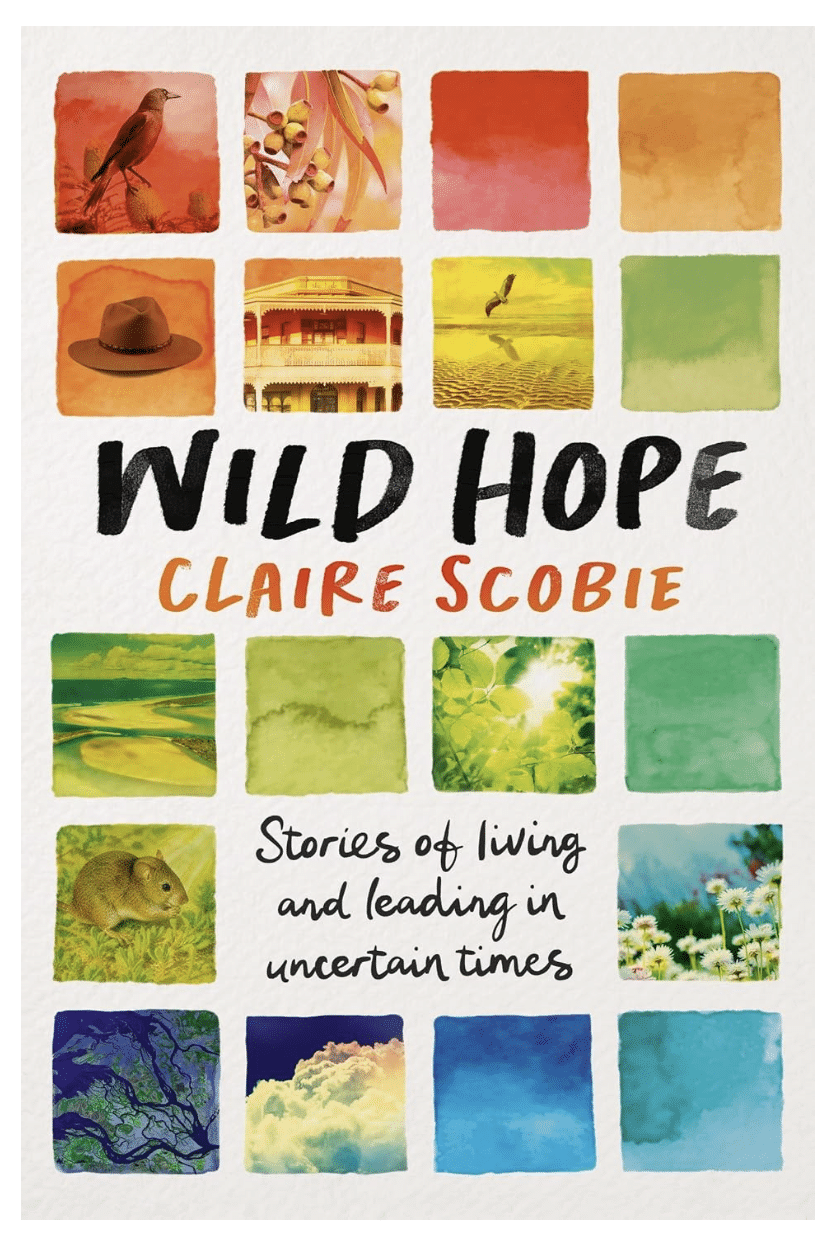
In this Sense-Making in a Changing World conversation, I speak with Dr Claire Scobie, award winning journalist and author of Last Seen in Lhasa, The Pagoda Tree and A Baboon in the Bedroom, and her newly released fifth book, Wild Hope: Stories of Living and Leading in Uncertain Times.
The book began with grief. In 2019, Claire read that a tiny marsupial called the Bramble Cay melomys, the only mammal known to live solely on one coral cay in the Torres Strait, had just become the first mammal declared extinct because of human induced climate change. She burst into tears. Her husband met her at the airport a few hours later, and gently told her to pull herself together.
That is not a trivial moment. It is, I think, exactly the moment so many of us recognise: the point where the state of the world stops being something out there, and becomes something felt.
“But through writing the book and the people I met, I realised that it’s perfectly possible to do both, to feel deeply and to get on with the day job.”
Why this conversation matters
Grief was where we began, but this is far from a heavy conversation. Claire’s research kept turning up story after story of what she calls unlikely leaders: people who never set out to change a system, and did.
She tells the story of Lee Robb, who came home to a small Northern Irish town that had been hollowed out by industrial decline, and started a community social media page called Positive Carrickfergus because she couldn’t keep saying to herself that the town was rubbish. It grew to seven thousand members. Three years later, a government minister launched Northern Ireland’s national food strategy in the greengrocer and co-op that grew out of that page.
“It started with her realising she had to change her internal narrative, and then start to change what she was hearing from other people.”
We talked about physicist Ilya Prigogine’s idea of islands of coherence, small pockets of change that stay local until the conditions are right for them to connect into something systemic. Claire traces this through the campaign to make Melbourne’s Yarra River swimmable again, which began with individuals swimming against the grain of a story that told them the river was a drain, and became a formal city commitment to a swimmable Yarra by 2050.
“We are here because of the river. The city is not.”
We also spoke about what Claire learned from her husband Aidan’s Gumbaynggirr culture, and from his uncle Gary Williams, who leads the Muurrbay Language and Culture Cooperative. In Gumbaynggirr, there is no separate word for nature. The stories of land, of ancestors, of country already carry all the knowledge a person needs. Nature was never something out there to reconnect with, because it was never separate to begin with.
“It’s not that you see a landmark out there. It’s that that land, that mountain, claims you as a human.”
Key ideas from this episode
Grief needs somewhere to go. It takes time, ritual and story to let big feelings become fuel rather than paralysis. Claire learned much of this through the Work That Reconnects, Joanna Macy’s methodology for staying present to the state of the world without shutting down.
Change starts hyperlocal. Not with a grand plan, but with your street, your school, the conversation over lunch with a colleague. That is our way in, because the bigger picture is often too vast to hold.
Islands of coherence become archipelagos. Small, local, seemingly unconnected acts of change stay local until the right conditions let them link up into something systemic. The sharing of these small stories is what lets that happen.
Stories already carry the knowledge of land. In Gumbaynggirr and in many First Nations cultures, there is no separate word for nature, because the stories of land and ancestors already hold everything needed to understand it.
Deep listening beats a fixed plan. Lee Robb thought she was starting a market garden. She ended up with a greengrocer and a co-op. The shape came from listening, not from arriving with the answer.
Real leadership names the truth. Paul Hawken told Claire that real leadership means knowing we are on a degenerative path right now, and that a good leader has to be willing to turn around, not just adjust course.
The veggie garden paradox is everywhere. Regenerative farmer Charles Massey noticed the same thing on farm after farm: a beautiful organic veggie garden by the farmhouse, and beyond it, depleted paddocks under conventional chemical farming. Two relationships with land, side by side, unexamined. It names the gap between what we know and how we act.
Unlikely leaders are already all around us. The people quietly changing their street, their town, their river rarely see themselves as leaders. That, Claire says, is part of the beauty of them.
This was the first time Claire and I had met and spoken, and after we stopped recording we kept talking for well over an hour. I loved this conversation, and I think you will too.
Find out more about Claire Scobie and her work:
→ Website and book: Wild Hope: Stories of Living and Leading in Uncertain Times, out September 1st
→ Substack
ABOUT THIS PODCAST
The Sense-Making in a Changing World podcast is an initiative of the Permaculture Education Institute hosted by Morag Gamble. It is broadcast from a solar powered studio in the midst of a permaculture ecovillage food forest on beautiful Jinibara and Gubbi Gubbi country.
We explore ‘what now’ – what thinking do we need to navigate a positive and regenerative way forward; what does a thriving one-planet way of life look like; and where should we putting our energy.
ABOUT THE PERMACULTURE EDUCATION INSTITUTE
Morag Gamble, founder of the Permaculture Education Institute, is an award-winning permaculture teacher, humanitarian, writer, film-maker and designer who has led programs for 3 decades in over 22 countries. She is an international leader of the permaculture movement for change.
Through the Permaculture Education Institute, Morag works with people on six continents, teaching permaculture design and skills, how to be a permaculture teacher and community leader, and how to create a regenerative permaculture livelihood.
You can start our course today, and take as long as you need.
Visit our website to find out more.

0 Comments